
Roadblocks of Shame: How Kenya’s Traffic Police Turn Bribes into an Unofficial Toll System
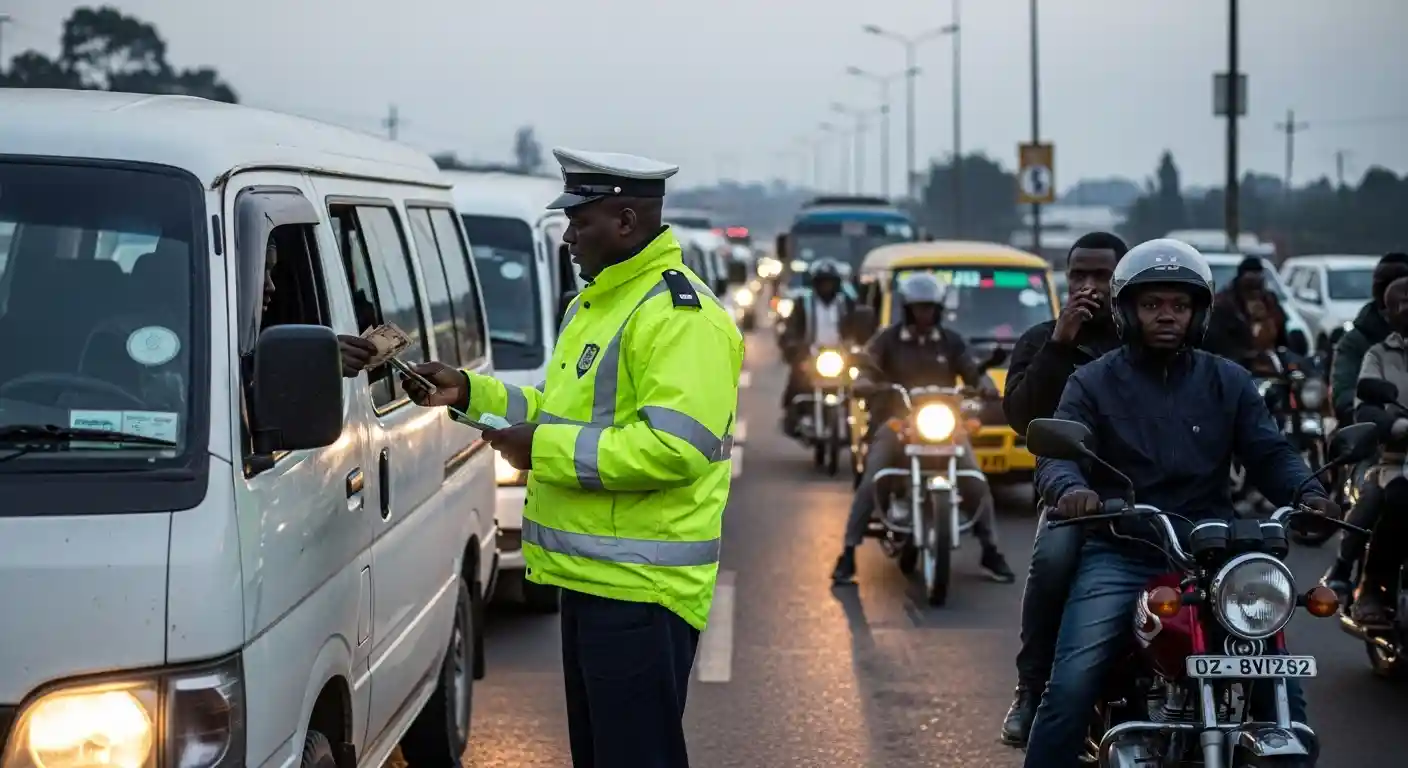
Every morning, before the sun burns the mist off Thika Road, James* pulls on his worn jacket, kisses his still-sleeping children, and walks out to the yard where his matatu is parked nose-to-tail with others. He is not just thinking about fuel, inspection stickers, or the city’s notorious traffic. He is calculating the unofficial “toll” he must pay to pass through the invisible gates manned by traffic police in reflective jackets, stationed at the same spots every day like employees on a shift rota at a private toll station.
Thank you for reading this post, don't forget to subscribe!The toll stations in uniform
By 6:30 a.m., the first “checkpoint” is already active. The officers know the SACCOs, the route numbers, even the drivers’ nicknames. The EACC audit confirms what every matatu driver in Nairobi has known for years: traffic police have turned enforcement into a structured extortion racket, complete with predetermined daily amounts demanded from PSVs, boda bodas, and businesses. Those who comply move on; those who resist risk fabricated charges, arbitrary arrests, and being dragged to court over invented offences.
The report describes how this is not random hustling by a few rogue officers, but systematic extortion, where “protection fees” are collected at route and station level and then channelled up the chain of command. For James, this is not a statistic; it is the quiet negotiation at 7:10 a.m. at the roundabout, the folded note passed with a forced smile, the passengers pretending not to see because everyone knows this dance and no one believes it will change.
Everyone knows, from the street to the top
The EACC’s systems examination of the National Police Service lays it bare: recruitment riddled with bribes and political interference, transfers traded like commodities, “price tags” on lucrative stations, and punishment postings for those who refuse to play along. Weak internal controls, underfunded oversight units, and poor detention conditions complete the picture of a Service where corruption is not an exception but an operating system.
And yet, this is an open secret. Commuters know that the “random” stop on Jogoo Road is not about safety but about collections. Police bosses know, because the report explains how collections are systematised and proceeds move upward, institutionalising bribery within the traffic unit. Legislators know; they are formally presented with EACC reports that detail these abuses and call for reforms, including disbanding the traffic unit and overhauling systems that enable extortion. The president and the entire Executive are not in the dark; the same reports are tabled as accountability statements, and the Inspector General has publicly received and acknowledged them with promises to act within set timelines.
A country pretending not to see
The most damning part of the EACC findings is not just what they reveal, but how familiar it all sounds. The Commission shows that traffic officers collect predetermined fees through SACCOs, that some officers pay to be posted to “juicy” traffic spots, and that under-resourcing of vehicles and fuel is used as justification for demanding bribes from the public. It also documents “protection fees” from businesses, inconsistent bail practices, and squalid detention conditions – all symptoms of a system where human dignity is traded for daily collections.
Yet as a country, the response often looks like ritual: a press conference here, a tough statement there, a headline about billions in assets being pursued or recovered – EACC chasing Kes49.5 billion in corruptly acquired assets and filing dozens of civil suits, even as daily extortion on the roads continues largely unchanged. Then life goes on. James still has to factor bribes into his daily target; commuters still budget extra time for “checks”; and citizens shake their heads and move on, as if corruption were the weather and not a crime being meticulously documented by a constitutional commission.
When law becomes theatre
On paper, Kenya has one of the more elaborate anti-corruption and integrity frameworks in the region: Chapter Six of the Constitution, the EACC Act, the Leadership and Integrity Act, the Anti-Bribery Act, and a long list of regulations. The EACC’s annual report notes dozens of completed investigations, advisories, and a pipeline of high-impact asset recovery cases – billions of shillings in play, hundreds of files forwarded for prosecution. Parliament is being asked to strengthen the legal framework further through new amendments, and the Commission publicly urges all arms of government and citizens to join the fight.
But laws that do not protect James on that misty morning at the roadblock begin to look like theatre. When a traffic officer treats the road like a private toll gate despite an official report recommending the disbandment of the unit itself, the distance between the Constitution and the matatu stage grows painfully obvious. The hypocrisy is staggering: a nation that speaks proudly of rule of law and integrity, while tolerating – and budgeting for – roadside extortion as a normal cost of doing business.
Refusing to keep our heads in the sand
The EACC has done what a watchdog is meant to do: document the rot, name the structures, recommend bold medicine – including scrapping the existing traffic unit, rotating officers, strengthening internal intelligence, and fixing recruitment and oversight. It has shown that corruption on our roads is not an accident of individual greed but the outcome of deliberate choices, underfunding, and a culture of impunity that flows from the streets to boardrooms and Cabinet meetings.
What remains is the hardest part: a collective refusal to pretend not to know. For James, that would mean a day when the reflective jacket at the roundabout signals safety, not a shakedown. For commuters, it would mean demanding more than talk from leaders who have read these reports and sworn oaths to uphold the Constitution. And for a country that has long buried its head in the sand, it would mean finally admitting that the bribe at the roadblock is not a small, necessary evil – it is the front line of a national betrayal that everyone already knows about, and no one can honestly claim not to see.
How the collections start on the road
- Frontline traffic officers at roadblocks and hotspots collect small cash payments from matatus, boda bodas, and other motorists, often framed as “protection fees” or to avoid fabricated offences.
- The audit shows these officers are not freelancing: many are given daily or periodic collection targets by their seniors, turning each roadblock into a quota-driven cash point.
- Some SACCOs or route associations even aggregate payments on behalf of their members and pass them through agreed channels, indicating that the system is predictable and organised rather than ad hoc.
Moving cash up the hierarchy
- EACC describes bribery as “highly organised,” with junior officers collecting under instructions from senior officers, then remitting a portion of the proceeds upwards.
- These flows are alleged to move from individual constables to their immediate supervisors (e.g., corporals, sergeants, OCS), and then further up to sub-county and county-level commanders, institutionalising corruption across ranks.
- The report links this system to deployment and disciplinary power: lucrative posts (busy highways, urban corridors, weighbridges) are sought-after because they generate higher collections, and officers may pay or lobby to be posted or retained there.
How bribes shape postings and discipline
- EACC found that recruitment, promotions, transfers, and disciplinary decisions are vulnerable to bribery and political interference, meaning officers who “feed the system” are more likely to get favourable postings or protection.
- Transfers are sometimes used as both reward and punishment – officers who fail to meet informal targets or resist extortion can be moved to less desirable stations, while compliant ones remain in “juicy” traffic assignments.
- This creates a feedback loop: money collected on the roads finances a shadow economy of postings and promotions, which in turn entrenches officers who are invested in keeping the racket alive.
Why the chain is hard to break
- Internal oversight is weak and under-resourced; the Internal Affairs Unit has limited regional presence and struggles to act on complaints, which allows this chain of collections and remittances to continue with low risk for higher-ups.
- Because the payments are mostly in small cash amounts spread across thousands of daily interactions, they are hard to trace, but their cumulative effect is large enough to influence behaviour at command level and distort the entire policing culture.
In short, the EACC report suggests that roadside bribes flow upward like an unofficial tax within the traffic department: junior officers collect, share upwards under pressure of targets, and the resulting money helps buy postings, protection, and silence higher in the command structure.
