
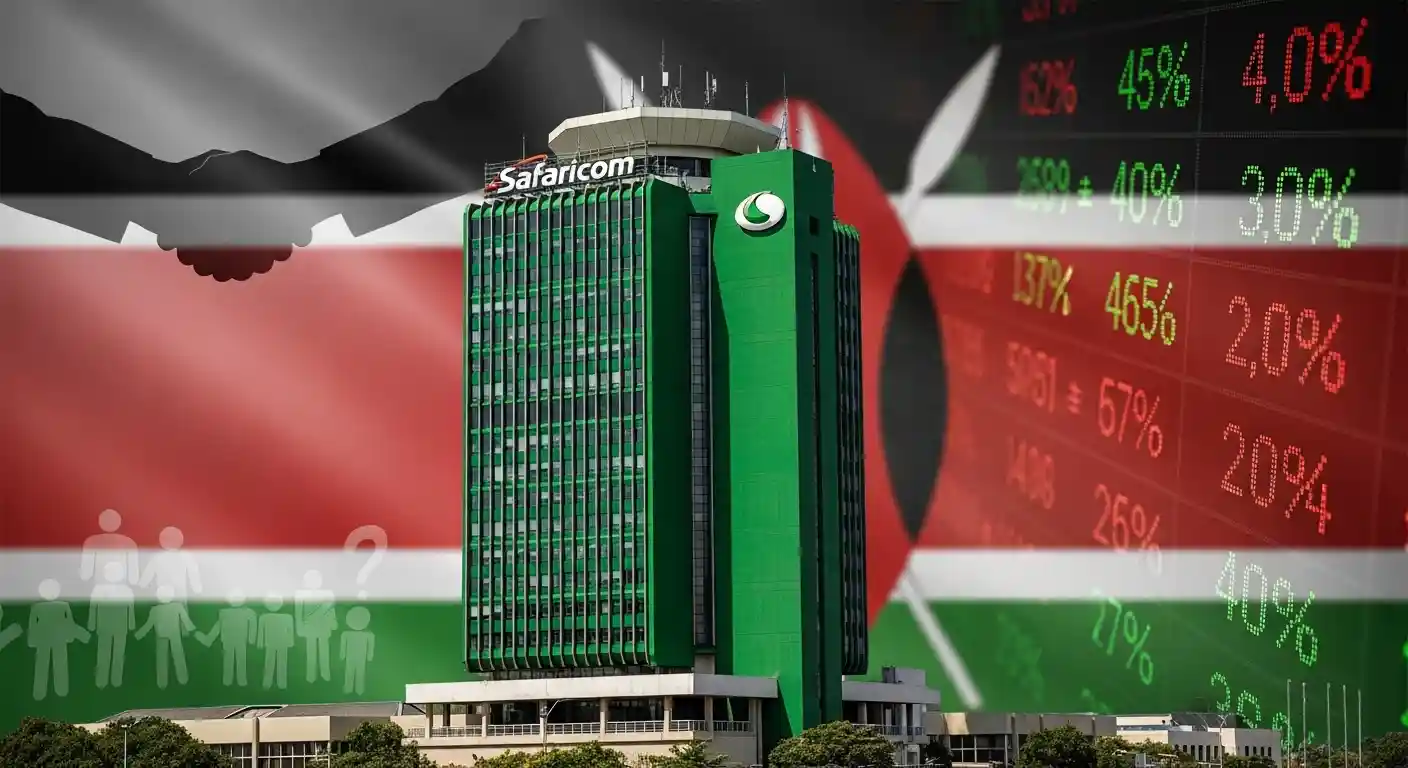
Safaricom Sale: Inside Kenya’s biggest stake sale yet
Kenya’s plan to sell part of its stake in Safaricom has moved from an abstract fiscal strategy to a concrete, market-shaping transaction. The Treasury still faces a tight mandate: raise about KES 149 billion from privatisation proceeds by mid-2026 to help plug a yawning budget deficit, ease pressure on debt, and create room in the 2025/26 fiscal framework. With few state assets capable of delivering that scale of cash quickly, Safaricom was always destined to become the centerpiece of this divestment programme. What has changed is the “how”.
Thank you for reading this post, don't forget to subscribe!The original debate around the Safaricom sale centred on the optimal mix of buyers and channels: how to balance price, stability, and inclusion. A sensible structure seemed to be a blend of a strategic block sale to anchor investors and a secondary public offer on the Nairobi Securities Exchange (NSE) to preserve broad Kenyan participation. That approach would ideally:linkedinSafaricom-Sale.docx
- Give government price certainty and speed via a negotiated block.
- Bring in sector-savvy long-term investors.
- Open the door for retail and local institutional investors through a public offer.
Instead, events have taken a more concentrated path. A major transaction has now been announced under which Vodafone Kenya will acquire a large part of the government’s stake at a set price of KES 34 per share, paying about KES 204.3 billion for 6.01 billion shares. This is one of the biggest equity deals in Kenya’s history and it comes at a premium to recent market prices, instantly delivering the Treasury a substantial fiscal windfall.
At the same time, the structure includes an additional KES 40.2 billion payment to the government in exchange for future Safaricom dividends that would otherwise have accrued to the state, effectively monetising a long-term income stream for immediate cash. Once completed, this reshuffle will cut the state’s equity stake from around 35 percent to roughly 20 percent, while a parallel reorganisation of Vodafone and Vodacom’s holdings lifts Vodafone Kenya’s direct and indirect interest in Safaricom to about 55 percent, granting it clear majority control without triggering a full takeover offer.
The Original Case: A Mixed Sale for Inclusion and Stability
The starting point for designing this transaction was straightforward. Safaricom remains Kenya’s most valuable listed company, the anchor of the NSE, and a systemically important player in telecoms, payments, and digital services. Any large-scale sale of the government’s stake needed to:
- Avoid flooding a relatively shallow market with shares.
- Protect Safaricom’s operational stability.
- Keep Kenyans meaningfully invested in the company’s success.
Given this, a “blended” structure still makes economic and political sense in principle:
- Block sale to strategic investors
A negotiated sale of a meaningful slice (say 10–20 percent) to high-quality strategic investors—global telcos, sovereign funds, or reputable institutional investors—can deliver price certainty, minimise market disruption, and bring sector expertise. - Secondary public offering (SPO) on the NSE
A modest SPO (for example 5–10 percent) would give Kenyan retail and institutional investors a fresh opportunity to increase their stake, deepen market liquidity, and reinforce the message that Safaricom’s growth story remains a shared national asset.
This is the structure the original article argued for: a calibrated mix of private placement and public offer to strike a balance between fiscal urgency, strategic control, and inclusive ownership.
What Has Actually Been Chosen
The emerging deal departs from this ideal. Rather than a twin-track path that deliberately carves out room for the Kenyan investing public, the current structure heavily favours a strategic block buyer—Vodafone Kenya—and for now leaves little sign of a parallel NSE window for retail and local institutions.
The advantages for the State are clear:
- Speed and certainty: A negotiated transaction delivers billions upfront without the execution risk associated with a large public offer.
- Pricing: The KES 34 per share price implies a premium to recent trading levels, reducing the political risk of accusations that the asset was sold cheaply.techcabal+1
- Budget relief: Combined with the dividend-rights monetisation, the deal sharply boosts non-tax revenues at a time when Kenya is under tight fiscal and external financing pressure.
However, the trade-offs are equally significant:
- Control concentration: With Vodafone Kenya ultimately stepping above the 50 percent threshold, effective control of Safaricom shifts decisively into foreign hands.
- Reduced recurring income: The sale of future dividend rights means the State foregoes a predictable income stream that has historically cushioned the budget.
- Limited local participation (so far): Absent a dedicated SPO or retail tranche, ordinary Kenyans risk being spectators rather than beneficiaries in the most important equity deal in the country’s history.
Can Kenyans Still Share in the Upside?
At Safaricom’s 2008 IPO, Kenyan investors oversubscribed the offer roughly five-fold, signalling deep appetite for quality corporate paper. Today, however, the domestic market’s capacity to absorb the entire government stake—now valued north of KES 200 billion—remains limited without external capital support. Pension funds, asset managers and high-net-worth investors can and likely will participate in the secondary market, but the sheer scale of this transaction means that foreign capital will inevitably be the main anchor.
That does not mean local investors must be locked out entirely. Policymakers and market regulators still have options:
- Encourage a structured NSE offer of a smaller slice in the next phase, specifically targeted at retail and domestic institutions.
- Design allocation rules and communication that avoid the perception of a closed-door sale.
- Use part of the proceeds to strengthen domestic capital markets infrastructure and investor education, so Kenyans benefit indirectly even if they do not buy shares immediately.
Safaricom’s Fundamentals Still Matter
All this is happening against a backdrop of robust, if evolving, Safaricom fundamentals. The company recently reported a 52.1 percent jump in half-year profit to KES 42.7 billion, driven by strong M-Pesa growth, solid data revenues and narrowing losses in Ethiopia. Mobile financial services revenue has pushed above KES 88 billion, while voice continues to shrink as a share of the revenue mix. Dividends remain attractive and the interim payout track record continues to support investor confidence.
These numbers explain why this stake sale is attracting such intense global interest: investors are not buying a turnaround; they’re buying a market-dominant cash machine with a credible regional growth story.
Policy Choices and the Road Ahead
Ultimately, the Safaricom stake sale intertwines three objectives:
- Fiscal: Raise cash quickly without overly burdening taxpayers.
- Strategic: Preserve Kenya’s influence over a systemically important digital infrastructure player.
- Social: Maintain the sense that Safaricom remains, in part, “owned” by Kenyans, not just in sentiment but in share registers.
The emerging Vodafone Kenya deal leans heavily toward the fiscal and strategic axes—Treasury gets cash; Safaricom gains a clear majority owner with deep sector expertise—but it scores poorly so far on broad-based local inclusion. The challenge for policymakers is to fine-tune the next steps: communicate transparently, design spaces for local participation, and ensure that the proceeds are deployed in a way that visibly improves Kenya’s economic resilience.
If handled well, this transaction can still be the template for a smarter, more mature privatisation wave: one that blends global capital with domestic opportunity. If mishandled, it risks becoming a case study in how to raise money quickly at the expense of long-term national influence and shared prosperity. The stakes, like the numbers, could not be higher.
