
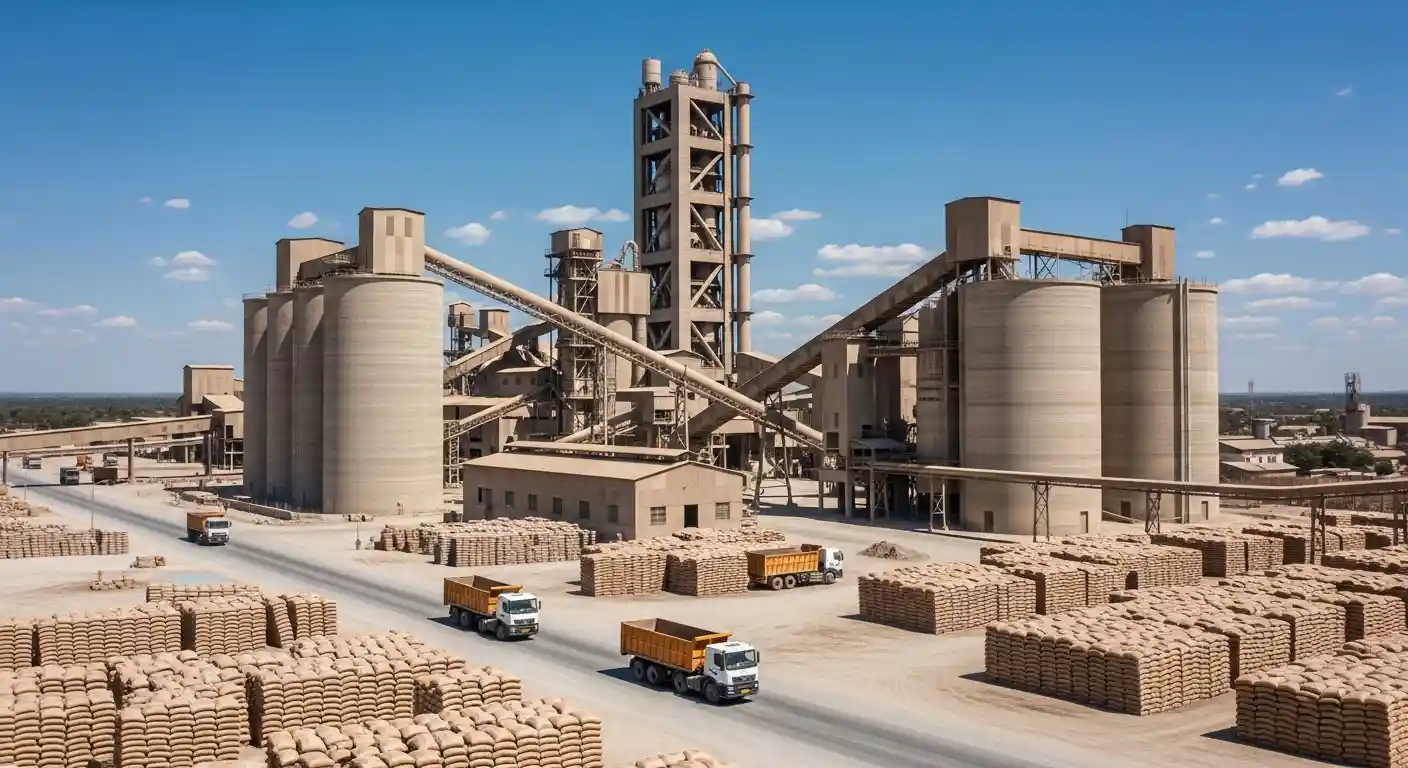
Amsons’ Cement Grip: How a Tanzanian Conglomerate Is Quietly Building Near-Monopoly Power in Kenya’s Cement Market
Amsons Group now sits at the centre of Kenya’s cement industry, with a web of direct and indirect stakes that gives it de facto system-wide influence even if it falls short of a textbook legal monopoly.
Thank you for reading this post, don't forget to subscribe!How close is Amsons to a monopoly?
Amsons, through Amsons Industries and related vehicles, controls about 96–97% of Bamburi Cement after a buyout concluded between late 2024 and early 2025, giving it command over Bamburi’s Athi River and Mombasa plants with roughly 3.5M tonnes per year of capacity. Via Kalahari Cement, an Amsons-linked vehicle, it has also secured a 29.2% stake in East African Portland Cement (EAPC) and is in the process of adding NSSF’s 27% holding, which will push its effective influence in EAPC toward or above 40–50% once fully consummated. When Bamburi’s pre-existing 12.5% in EAPC is added, analysts estimate that interests tied to Amsons will collectively sit above the 40% line in Portland, enough to shape strategy, alliances and management even without formal majority voting control.
Taken together, this means one Tanzanian-anchored conglomerate has outright control of the market leader (Bamburi) and dominant influence over one of Kenya’s oldest producers (EAPC), in a market where total national capacity is around 16M tonnes and Bamburi already ranked as the largest single player.
Why the regulators have allowed it
The Competition Authority of Kenya (CAK) and the Capital Markets Authority (CMA) have leaned heavily on technical definitions to wave the deals through. CMA treated Kalahari’s Portland stake as a “private transaction” and granted exemptions from mandatory takeover rules, arguing that no full change-of-control event, in the narrow legal sense, was triggered by the 29.2% block purchase. CAK, when questioned in Parliament, is reported to have argued that the combined Amsons/Bamburi/Kalahari interest in EAPC does not amount to a direct acquisition of control under the Competition Act and thus does not require the full merger control process.
Both regulators have also leaned on a public-interest storyline: that fresh capital from Amsons will rescue distressed assets, preserve jobs and secure long-term investment in local clinker capacity and exports, which they frame as outweighing theoretical concentration risks in the short term.
Political undertones and perceived interests
The speed and generosity of regulatory exemptions have fuelled speculation that senior political interests are either backing or co-invested in the Amsons push, especially around Portland’s land bank and its historic status as a state-linked firm. Parliamentary committees have openly raised questions about transparency, alleging “secret” sale processes and hinting at politically connected beneficiaries in the background of both the Bamburi and EAPC deals, even if no regulator has formally cited political pressure.
Media commentary has also noted the geopolitical undertone: a Tanzanian group tightening its grip on Kenyan strategic manufacturing assets at a time when regional politics and infrastructure contracts are deeply intertwined with state-level relationships and elite business networks.
Implications for prices, investment and competition
In market terms, Amsons’ near-systemic position creates three big risks:
- Pricing power: With control over Bamburi’s premium brands and heavy influence at Portland, Amsons gains scope to lead pricing, especially in Nairobi and the Coast, with rivals forced to follow rather than set independent benchmarks.
- Entry deterrence and consolidation: Smaller and mid-tier players may struggle to match the combined logistics, distribution and marketing muscle of Bamburi–Portland under Amsons, accelerating consolidation or even quiet exits, particularly in marginal regions.
- Regulatory capture: Repeated exemptions and narrow readings of “control” set a precedent that large regional conglomerates can structure around takeover and merger rules, making it harder for regulators to police future dominance claims.
The upside scenario is that Amsons uses its scale to push real investment into new clinker lines, alternative fuels and product innovation, which could boost capacity, improve efficiency and, in theory, stabilise prices over the long term if demand keeps growing. The downside is a classic oligopoly: high concentration, high margins, modest innovation and a policy environment that constantly lags corporate manoeuvres.
Who are the main competitors and what do they control?
The current Kenyan cement landscape, simplified, looks roughly as follows:
- Bamburi Cement (Amsons-controlled) – Historically the market leader, with about 3.5M tonnes per year of capacity across Athi River and Mombasa plants, plus distribution reach into Uganda and the region.
- East African Portland Cement (EAPC) – Roughly 1.3–1.5M tonnes of nameplate capacity around Athi River, but historically under-utilised; now under strong Amsons/Kalahari/Bamburi influence through a combined 40%+ shareholding.
- Devki Group / National Cement (Simba) – A major local rival with integrated clinker and cement capacity in Athi River and Emali and significant control in the lower-priced mass market segment as well as some export flows.
- Mombasa Cement – A large coastal player with plants in Mombasa and Vipingo, reputedly controlling a strong share of the Coast and parts of the Nairobi market with relatively aggressive pricing.
- Savannah Cement – Owner of a 2.4M-tonne Athi River plant, recently taken over by a consortium of local flour millers (Mombasa Maize, Kitui Flour Millers, Eldoret Grains), giving it a fresh capital lifeline but still a smaller player compared to Bamburi and National.
In this configuration, Amsons is not the only big player—but it is the only one with a controlling grip on the historical market leader plus a decisive voice in a second legacy producer, positioning it as a “first among equals” in what is fast becoming a tightly contested oligopoly rather than a fragmented field.
What the Kalahari–EAPC deal changes
Kalahari Cement’s push for effective control of East African Portland Cement (EAPC) signals a decisive shift toward a more consolidated, vertically integrated, and regionally dominated Kenyan cement industry. Over roughly the last year, the sector has moved from post-slump recovery and ownership uncertainty to aggressive M&A, rising output, and renewed construction demand.
What the Kalahari–EAPC deal changes
Kalahari Cement, tied to Tanzania’s Amsons Group, already holds about 29.2% of EAPC and has now signed a Sh1.6 billion deal to buy NSSF’s 27% stake, taking its effective control to nearly 70% once approvals are secured. This will give a single regional group decisive influence over EAPC’s strategy, capex and pricing while keeping the company formally listed and avoiding a full takeover offer through repeated exemptions from the Capital Markets Authority.
EAPC’s management and Amsons frame the deal as a turnaround partnership focused on capital injection, plant upgrades, and unlocking underused limestone and land assets to restore Portland as a viable competitor rather than a failing, politically contested parastatal. However, MPs and some industry watchers worry about regulatory arbitrage, governance opacity around the exemptions, and the risk that a cross-border group with interests in Bamburi and Kalahari could exercise outsized market power in pricing and in access to clinker and distribution networks.
Market structure and competition implications
If Kalahari secures NSSF’s stake, interests linked to Amsons/Kalahari/Bamburi will control well over two-thirds of Portland while also owning Bamburi outright, tightening regional control over capacity and market share in central Kenya. That concentration could deliver efficiencies—shared logistics, coordinated clinker sourcing, and rationalised production lines—but it also raises classic dominance risks: coordinated pricing, pressure on smaller independent players, and reduced incentive to invest in excess capacity that would discipline prices.
Given that 2025’s demand surge has come with still-elevated bag prices (around KSh 780–855 per 50kg), there is a real question whether new strategic investors will prioritise volume and competitiveness or margin protection in a tighter oligopoly. Parliamentary scrutiny and the Competition Authority’s stance will therefore be central in determining whether this becomes a disciplined, growth-oriented consolidation or an arrangement that locks in high prices for public and private builders.
How the industry has transformed in the last year
Over the last 12–18 months, the Kenyan cement sector has shifted from a 2024 slump to its strongest half-year growth since 2023, with production up about 17% in H1 2025 to roughly 4.85 million tonnes and consumption up about 20–22% to around 4.76 million tonnes. Monthly output has consistently crossed 800,000 tonnes since early 2025, and by August 2025 production hit about 920,000 tonnes, with consumption around 907,000 tonnes as housing, infrastructure, and commercial projects resumed pace.
This demand recovery followed a 2024 construction contraction and has been supported by macro shifts: easing monetary policy, some fiscal push on affordable housing, and a gradual clearing of stalled public projects. The period has also seen major ownership churn: Holcim’s exit, Amsons’ takeover of Bamburi, and now Kalahari’s layered entry into EAPC, effectively reshaping who controls key clinker and milling assets in Kenya and the wider East African corridor.
Strategic and policy angles to watch
In the near term, Kalahari’s deeper stake in EAPC could stabilise a historically troubled asset, unlock plant modernisation, and increase capacity utilisation just as demand and GDP growth are picking up again. For contractors and developers, a successful Portland turnaround would broaden supply options around Nairobi and potentially support more specialised products (e.g., blended and white cements) as investors chase margin niches.
The policy risk is that consolidation outpaces regulation: if exemptions from takeover rules become routine and dominance concerns are not tightly managed, Kenya could end up with a less contested market at exactly the moment cement demand is recovering strongly. Going forward, the key indicators for any news analysis will be pricing trends, investment in new clinker capacity versus import reliance, and whether smaller players expand or retreat in the face of Amsons-anchored regional power blocs.
