
Why Safaricom’s Tax-Free Green Bond Could Reboot Kenya’s Corporate Debt Market
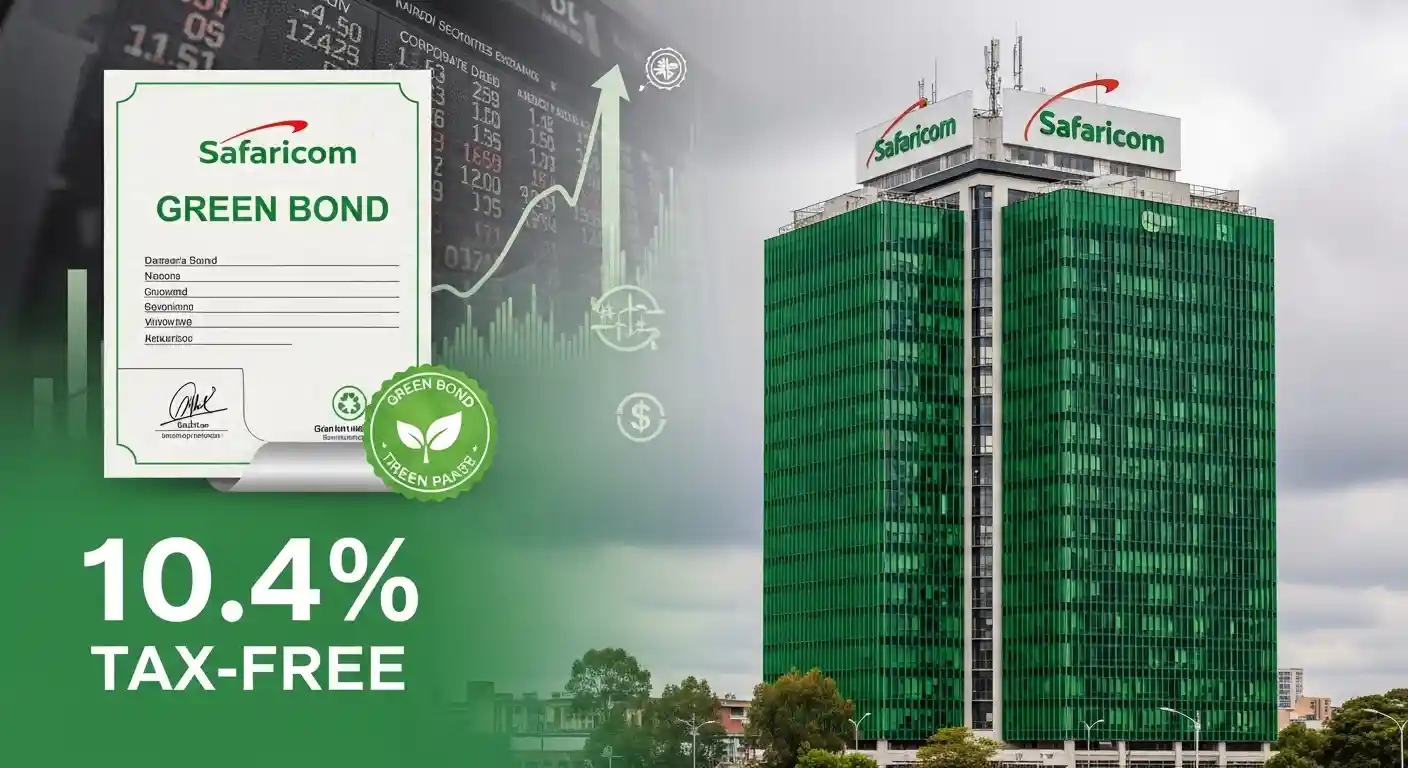
Safaricom’s tax-free green bond offers retail investors a rare combination of high yield, tax efficiency, and blue-chip credit quality at a time when alternatives with similar risk–return profiles are scarce in Kenya’s fixed-income market.
Thank you for reading this post, don't forget to subscribe!Safaricom bond basics
Safaricom’s KSh 40 billion domestic medium-term note programme has opened with a KSh 15 billion green bond tranche, with a greenshoe option to raise an extra KSh 5 billion in case of oversubscription. The debut note is a senior, unsecured green bond with a five-year tenor, paying a tax-exempt coupon of 10.4 percent, and the offer window runs from 25 November to 5 December 2025 with a minimum investment of KSh 50,000 and top-ups in KSh 10,000.
Why the “tax-free” feature matters
Under Kenyan law, interest income on qualifying green infrastructure bonds with a tenor of at least three years is exempt from the usual 15 percent withholding tax, so investors receive the full 10.4 percent coupon in cash. On a tax-equivalent basis, that translates to roughly 12–12.4 percent before tax, which compares favourably with many recent corporate issues and even some government papers of similar or longer maturity.
Relative value versus other bonds
Recent commentary shows a 10-year government bond trading near 13.0 percent, but this is taxable, and its effective after-tax yield can fall below the Safaricom bond’s tax-free payout for many investors. Analysts also note that the 10.4 percent tax-free rate exceeds the headline yield on other high-grade corporate issues like East African Breweries Limited’s recent bond, underlining that investors are being paid a premium despite Safaricom’s low-risk profile.
Credit quality and use of proceeds
Safaricom reported a more than 50 percent jump in half-year profit to about KSh 42.7 billion, supported by strong M-Pesa growth and moderating Ethiopia losses, which underpins its capacity to service debt comfortably. Proceeds from the green note are earmarked for environmentally aligned infrastructure projects in Kenya and Ethiopia, aligning the bond with ESG mandates and potentially broadening institutional demand beyond traditional income-focused investors.
Why investors should “snap it up”
Several features make this issue particularly compelling for retail and institutional buyers:
- A tax-exempt 10.4 percent cash yield from a top-tier issuer at a time when policy makers are nudging market rates lower.
- Strong brand strength and profitability at Safaricom, which historically translates into tight secondary-market trading and good liquidity compared to most Kenyan corporates.
- Convenient subscription channels, including mobile and online, which lower transaction barriers and mirror the successful M-Akiba model but with corporate, not sovereign, risk.
Risks investors should weigh
Investors still face standard bond risks, including interest-rate risk if yields rise in the future and price volatility in secondary trading before maturity. As an unsecured note, the bond ranks behind secured creditors in an extreme insolvency scenario, and investors are also indirectly exposed to execution risks around Safaricom’s Ethiopia expansion and green project pipeline, even though the company’s current metrics look robust.
State of the private bonds market in Kenya
Kenya’s listed corporate bond segment has been subdued for years, with only about KSh 25.9 billion outstanding at the Nairobi Securities Exchange across a handful of issuers such as East African Breweries, Family Bank, Kenya Mortgage Refinance Company, Linzi Finco Trust, and Batian Income Properties. Market trust was badly damaged by earlier defaults and distress cases, including Imperial Bank and micro-lender Real People, which left many investors wary of corporate paper outside top credits.
Growth of private placements and off-market debt
Away from the NSE list, Kenyan corporates have increasingly turned to private placements—bespoke bonds or loans sold directly to selected investors—to raise funding more quietly and flexibly. Recent examples include private bonds and green notes by firms such as 4G Capital, Burn Manufacturing, and Guaranty Trust Bank’s Kenyan unit, often in relatively small sizes (around KSh 0.5–1.4 billion) and structured for specialist or institutional investors rather than mass retail.
Where Safaricom’s bond sits in that landscape
Safaricom’s programme blends features of the public and private markets by using a listed domestic note structure while introducing ESG labelling and digital subscription rails that have become common in private and bespoke deals. For Kenya’s bond ecosystem, the issue is expected to revive corporate debt as a credible alternative to bank loans and government securities, and its performance will likely set the tone for future corporate and green bond offerings in the country.


